
How to Easily Remove Junk From Your Storage Unit
By Joe Scorpio, Junk Jaws · April 29, 2026 · Chicago & Chicagoland
At some point, you made a decision that felt completely reasonable. You needed more space, or you were in the middle of a move, or you inherited things that deserved better than the curb but did not have an obvious place to go. So you rented a storage unit. You paid the first month. You told yourself it was temporary.
That was probably not last month.
For a significant portion of Chicago storage unit renters, the unit has been sitting locked and largely unvisited for a year or more. The monthly charge hits the credit card automatically. The mental tab of “I really need to deal with that” stays open in the background, accumulating low-grade stress alongside the bill. The actual contents of the unit have become something between a mystery and a responsibility, and the longer it sits, the harder it feels to start.
This article is for the person who is ready to close that tab. Not just the mental one, but the financial one, and the legal one that most storage unit renters in Illinois do not know exists until it is too late.
What follows is a clear-eyed look at what your storage unit is actually costing you, what Illinois law says about what happens if you fall behind on payments, what the process of clearing a unit actually looks like when you do it with professional help, and how to get from “I need to deal with this” to “it’s done” in a single scheduled visit.
The Storage Unit Is Not a Pause Button. It Is a Running Meter.
The way most people think about a storage unit is as a holding area: a neutral space where things wait without consequence until you are ready to deal with them. That mental model is the core of why units sit for years. If there is no urgency, there is no action. And if the monthly charge has become small enough to stop noticing, the urgency never builds.
But the storage unit is not neutral. It is a running meter, and it has been running since the day you signed the rental agreement.
The Financial Math of Postponement
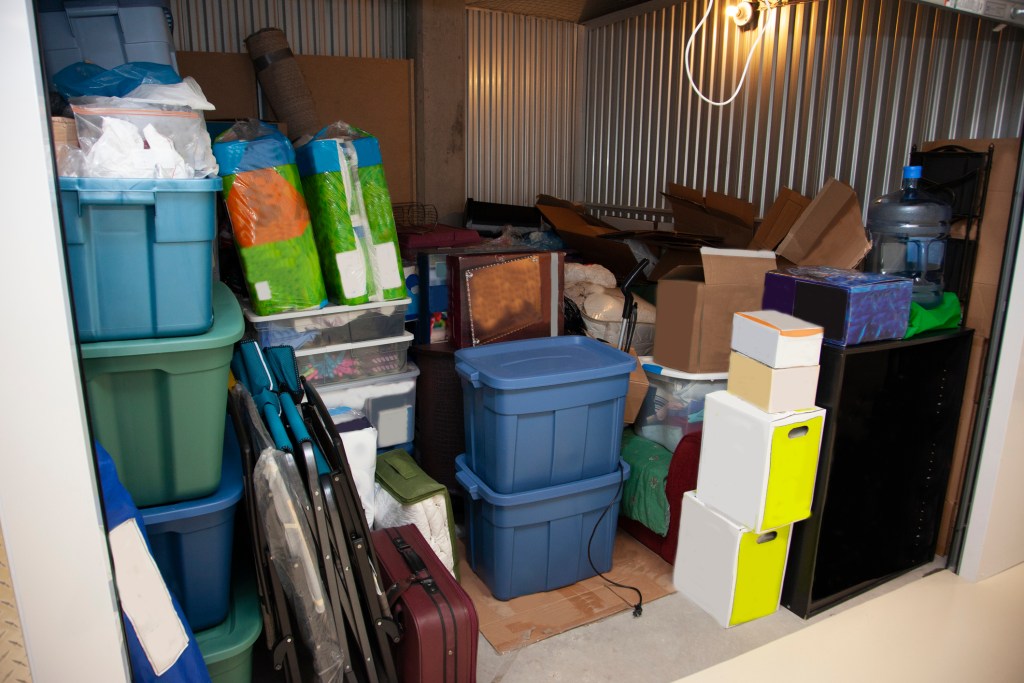
Add up the months your unit has been active and multiply by the monthly rate. For most Chicago-area storage renters, that number is larger than they have consciously acknowledged. What makes it particularly difficult to look at directly is that the total paid has almost certainly exceeded the replacement value of most of what is inside. The furniture that felt too good to throw away has been costing more to store than it would cost to replace it with something new. The boxes that have not been opened since the unit was packed contain items whose value, if any, is now primarily sentimental.
None of this is a judgment about the original decision. Storage units serve a genuine purpose at the right moment. The problem is when the “right moment” passes and the unit continues by inertia rather than intention. At that point, the monthly payment is not buying storage. It is buying postponement, and postponement compounds.
The Space Cost Beyond the Bill
Beyond the direct financial cost, there is a subtler drain that chronic storage unit renters frequently describe once the unit is finally cleared: the cognitive weight of an unresolved obligation. Knowing that something needs to be dealt with and not dealing with it does not stay neatly in a corner of your mind. It resurfaces during unrelated decisions, creates low-level decision fatigue, and occupies mental real estate that could be used for something else.
Clearing a storage unit is not just a logistical task. It is a resolution. And the relief that follows it is reliably larger than most people expect before they do it.
What Illinois Law Actually Says About Your Storage Unit
Most storage unit renters think of the relationship with their facility as a simple month-to-month rental. Pay the bill, keep the unit. Stop paying, lose access. That framing misses a significant part of the legal picture.
The Illinois Self Storage Facility Act
The Illinois Self Storage Facility Act, codified at 770 ILCS 95, governs the relationship between storage facility operators and their tenants throughout the state. Under this law, when a tenant falls behind on rent, the facility does not simply lock them out. The facility acquires a lien on the contents of the unit.
That lien has teeth. After the facility provides proper written notice and the required waiting period passes, the facility has the legal right to auction the contents of the unit to recover the unpaid balance. The auction can be conducted online or in person. The tenant has the right to pay the outstanding balance and reclaim the contents before the auction closes, but once the auction is complete and items have been sold, that right is gone.
This is not a rare edge case. Storage unit auctions are a documented, common occurrence in the Chicago area. Facilities rely on the lien process as a routine part of their business model, and they are legally permitted to execute it efficiently once the statutory requirements are met.
What This Means for the Renter Who Is Falling Behind
If you are current on payments, the lien is not an immediate concern. But if you are behind, or if you are considering simply stopping payment rather than formally closing the unit, the lien law means you may be giving up your control over the contents without realizing it. Items of real sentimental or financial value can be auctioned alongside everything else once the process begins. The facility’s obligation is to follow the statutory notice requirements. It is not to preserve your access to specific items you care about.
The only way to maintain full control over what happens to your belongings is to clear the unit before the lien process begins. A professional storage unit cleanout completed while you are still current on payments gives you the time to sort, donate, and dispose of items on your own terms rather than the facility’s.
The Vague Approach and Its Consequences
The vague approach to an overdue storage unit looks like this: the renter intends to clear it out before anything serious happens, keeps meaning to get around to it, misses a payment or two, receives a notice, panics, and then either scrambles to pay arrears without actually solving the underlying problem or loses items they would have handled differently if they had acted earlier.
The professional approach starts with a scheduled date. Everything else follows from that one decision.
Why the Unit Has Been Sitting This Long: The Real Obstacles
If clearing the unit were simply a matter of wanting to do it, most people would have done it already. The reasons units sit for years are worth naming clearly, because understanding them is the first step to moving past them.
The Scope Problem
Many storage units were packed quickly under time pressure, which means they are not organized in a way that makes sorting feel manageable. Opening the door and seeing a floor-to-ceiling stack of boxes, furniture, and miscellaneous items with no obvious system is a reliable way to close the door again and defer for another month. The scope feels larger than a single visit can address, and so no visit happens.
A professional team changes this dynamic entirely. The question is no longer whether you can manage the scope yourself. The scope becomes someone else’s job to execute, and your job is simply to make decisions about what stays and what goes.
The Decision Fatigue Problem
Every item in a storage unit represents a decision that was deferred. Clearing the unit means making all of those decisions at once, which is genuinely exhausting. Items with sentimental value are particularly difficult because they do not fit neatly into “useful” or “useless” categories. A box of photographs, a piece of furniture that belonged to a parent, a collection that made sense at a different stage of life: these items slow the process down because they require a different kind of consideration than a broken appliance or a box of outdated cables.
The practical solution is to separate the decision problem from the removal problem. Decide what leaves the unit in broad categories: things coming home with you, things going to donation, things going to disposal. A removal team handles the physical execution of those categories. You do not have to hold every item and deliberate over it individually.
The Coordination Problem
Many people assume clearing a storage unit requires a truck, a free weekend, helpers, and a plan for where everything goes. That assumption makes the project feel like a significant production, which is why it gets bumped in favor of easier tasks indefinitely. In reality, one phone call and one scheduled appointment hands the logistics to a team that brings the truck, the crew, the disposal infrastructure, and the process. The coordination problem dissolves when someone else is doing the coordinating.
What a Professional Storage Unit Cleanout Actually Looks Like
For people who have never used a professional junk removal service for a storage unit, the process is simpler than most expect and more thorough than most DIY attempts manage to be.
Before the Appointment
The process starts with understanding how the service works and what to expect. You do not need to pre-sort the entire unit before the team arrives. You do need a rough sense of what categories of items are inside and whether there is anything you want to pull out and take home before removal begins. If you have already sorted and know exactly what is leaving, the appointment moves faster. If you need the team to help work through the unit with you, that is also a workable starting point.
Notify the storage facility that you are clearing the unit. Most facilities require advance notice before you close an account, and knowing your move-out date allows them to process the paperwork and release you from further rent obligations promptly.
The Day of the Cleanout
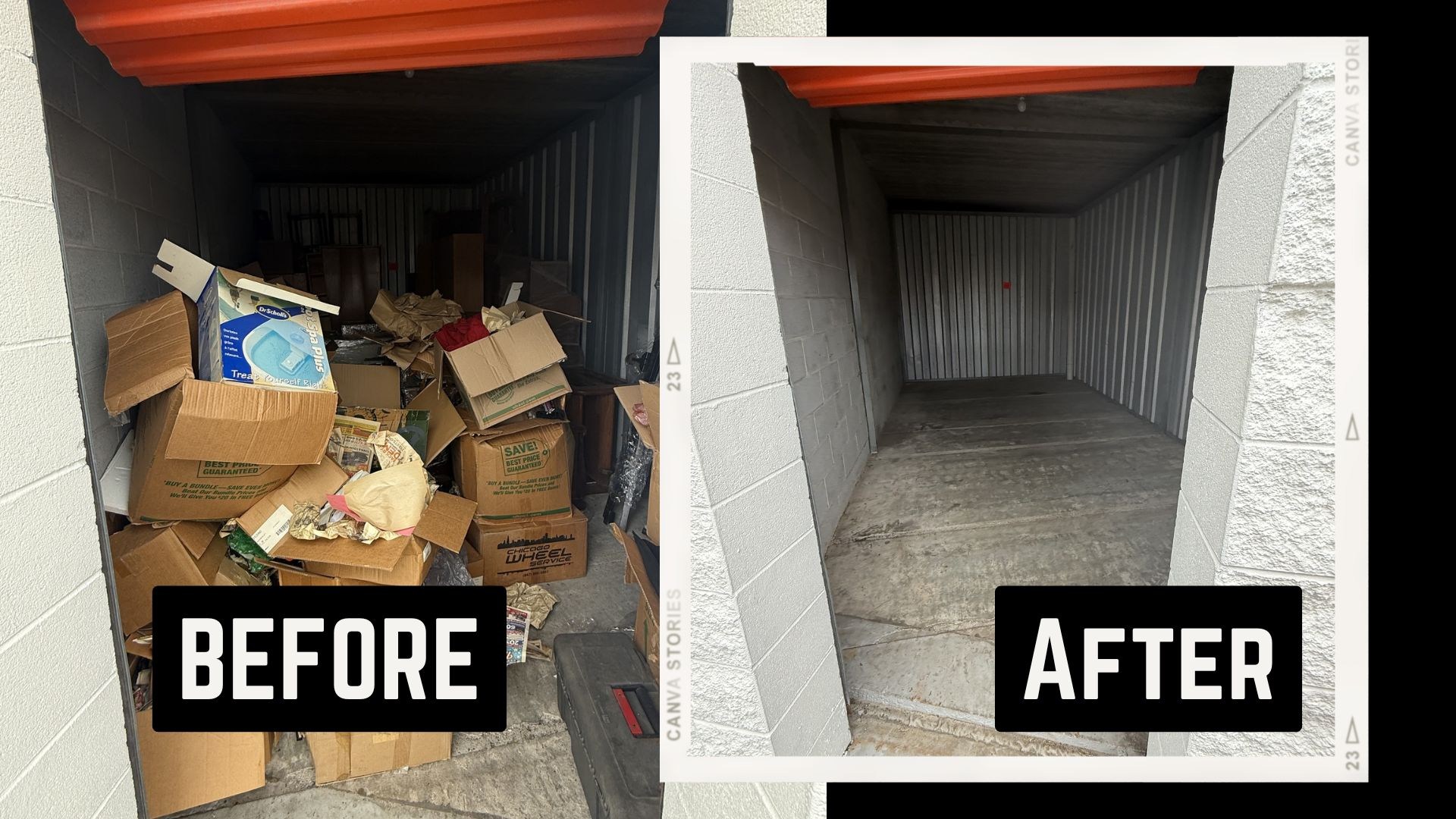
The team arrives at the storage facility, assesses the unit, confirms the scope and the final price before any work begins, and starts removal once you approve. Items are sorted as they come out: furniture and household goods in usable condition are set aside for donation, materials that can be recycled are separated, and what remains is loaded for disposal. The unit is cleared completely, not partially, and left in the clean condition the facility requires for move-out.
For units that are particularly full or contain very heavy items, the team has the equipment and crew to handle the job without requiring you to manage any of the physical logistics. You are present to make decisions. The team handles execution.
After the Appointment
Once the unit is cleared and the facility confirms your account is closed, the monthly charge stops. The mental tab closes. The items that had value found their way to people who can use them, handled through Junk Jaws’ donation and recycling process, which is the same approach described in detail in the post on what happens to your junk after it’s hauled away.
What is left for you is a closed account, no more automatic charges, and the particular clarity that comes from having resolved something that has been unresolved for a long time.
The Donation Question: What Is Actually Worth Keeping Out of the Pile
One of the most common concerns people have before a storage unit cleanout is whether items they care about will end up in a landfill. It is a reasonable concern, and it is the reason that sorting intent matters more than sorting detail when you are preparing for a professional cleanout.
What Tends to Have Reuse Value
Furniture in working condition, particularly solid wood pieces, is consistently accepted by Chicago-area donation organizations. Household goods including kitchenware, linens, and small appliances that function correctly have strong reuse potential. Clothing, books, and tools in reasonable condition are reliably redirectable. If you are uncertain whether a specific item has donation value, the general rule is that anything you would give to a friend rather than apologize for is something a donation organization can likely place.
For a more specific breakdown of what is typically worth setting aside for donation versus disposal, the post on items to donate instead of throwing away covers the categories that most often get discarded unnecessarily.
What the Professional Process Does Differently
The difference between a professional removal process and an informal or DIY approach is not just speed. It is the sorting infrastructure. An informal hauler with a truck and a willingness to work cheap has no donation network, no recycling process, and no incentive to do anything other than take everything to the nearest disposal site. The lower price reflects the lower standard of care for where your items end up.
A professional team with established donation partnerships and recycling processes routes items toward their highest and best use rather than their cheapest disposal path. For the person clearing a storage unit with items that have real sentimental or practical value, that distinction matters.
Storage Units Connected to Larger Life Transitions
Not every storage unit is full of random accumulation. Some units were opened during a specific life event and carry a particular emotional weight because of it.
Units Opened During a Move
The storage unit that was rented as a temporary measure during a residential move is one of the most common types. The move happened, the new space filled up, and the unit became the holding area for everything that did not make the cut the first time. Clearing it is the final step of a move that was never quite finished. For anyone in this situation who needs a parallel house cleanout to address both the unit and accumulated items at the new address, scheduling both in a coordinated sequence is the most efficient way to close both loops at once.
Units Opened After a Death in the Family
Some storage units were rented to hold a family member’s belongings after a death, at a moment when there was neither the time nor the emotional bandwidth to sort through everything properly. A year or more later, the unit is still there, and the decision about what to do with the contents has been deferred alongside the grief that made it difficult in the first place.
This is one of the most sensitive storage unit situations, and it is one that Junk Jaws approaches with the same care it brings to estate cleanouts directly from a family home. The team understands that items in a storage unit connected to a death are not just objects. They work at a pace that respects the difficulty of the situation while still moving the process forward to a resolution.
Units That Started as Overflow and Became Habit
Some units do not have a dramatic origin story. They started as overflow from a home that ran out of space and became a permanent fixture of the monthly budget by habit. These are often the units with the most accumulated volume, because without a specific event driving the contents, the accumulation has been ongoing for years. In some cases, the volume inside reflects a pattern of acquisition and avoidance that is worth addressing directly, and the hoarding cleanout experience that Junk Jaws brings to more complex residential situations applies here as well.
The Professional Advantage: Why This Is Not a Job for a Pickup Truck and a Free Saturday
The DIY storage unit cleanout has a familiar arc. You reserve a Saturday, recruit a friend or family member, drive to the facility, open the unit, and immediately realize the scope is larger than you remembered. You spend two hours moving things around inside the unit, load one truck’s worth, argue about what to do with three items that do not fit cleanly into any category, and leave having made a partial dent. The unit is still active. The monthly charge continues. The resolution that felt close is now scheduled for “next month.”
A professional team with the right vehicle, the right crew size, a clear scope confirmed before the job begins, and a documented disposal process completes the job in a single visit. The unit is empty. The account is closed. The next monthly charge never arrives.
That outcome, achieved in one appointment rather than three partial attempts, is the actual value of professional service. It is not a luxury. It is the difference between a problem solved and a problem reorganized.
The Clean Slate: Life After the Storage Unit
The people who have cleared a long-held storage unit and closed the account consistently describe the result in terms that go beyond the practical. The monthly charge stopping is satisfying in a concrete way. But what they describe most often is the absence of something that had been present for a long time: the background awareness of an unresolved obligation.
That absence is the clean slate. It is not dramatic. It does not look like anything from the outside. But it is a real and measurable change in the texture of daily life for people who carry the weight of unfinished business longer than they should have to.
You know what is in the unit. You have been paying for it long enough. The decision to close it is the one you have already made a dozen times in the back of your mind. The only thing that has been missing is the mechanism to execute it cleanly, completely, and without requiring a production-level weekend operation to pull off.
That mechanism exists, and it is one appointment away.
Ready to Close the Unit for Good?
Junk Jaws serves Chicago and the greater metro area and handles storage unit cleanouts of every size and complexity. The process is the same on every job: upfront pricing confirmed before any work begins, a crew that handles the full scope in a single visit, and a disposal process that routes usable items to donation and recyclables to appropriate processors rather than sending everything to a landfill.
You can book your appointment online or call (833) 586-5529 to talk through the scope before you commit to anything. The unit has been waiting long enough. One call closes it.
Frequently Asked Questions About Storage Unit Cleanouts in Chicago
What happens if I stop paying for my storage unit in Illinois?
How do I figure out what to keep, donate, and throw away when cleaning out a storage unit?
Can Junk Jaws help me sort through the unit, or do I need to pre-sort before they arrive?
How long does a storage unit cleanout in Chicago typically take?
What happens to the items Junk Jaws removes from a storage unit?
Ready to clear it out?
Junk Jaws is a family-owned crew serving Chicago and the surrounding suburbs. We do the lifting, the loading, and the disposal — you just point at the pile.

Joe ScorpioJoe writes for Junk Jaws, a family-owned junk removal company serving Chicago and the surrounding suburbs since 2022. More about the team.
Ready to make room? Let's haul it away.
Call our Chicago team for a free, no-obligation quote — or request one online and we'll get back to you the same day. Up-front pricing, no hidden fees, ever.